Before You Search Epoxy Flooring Near Me, Decide How Much Grip the Floor Needs
On 2026-10-23
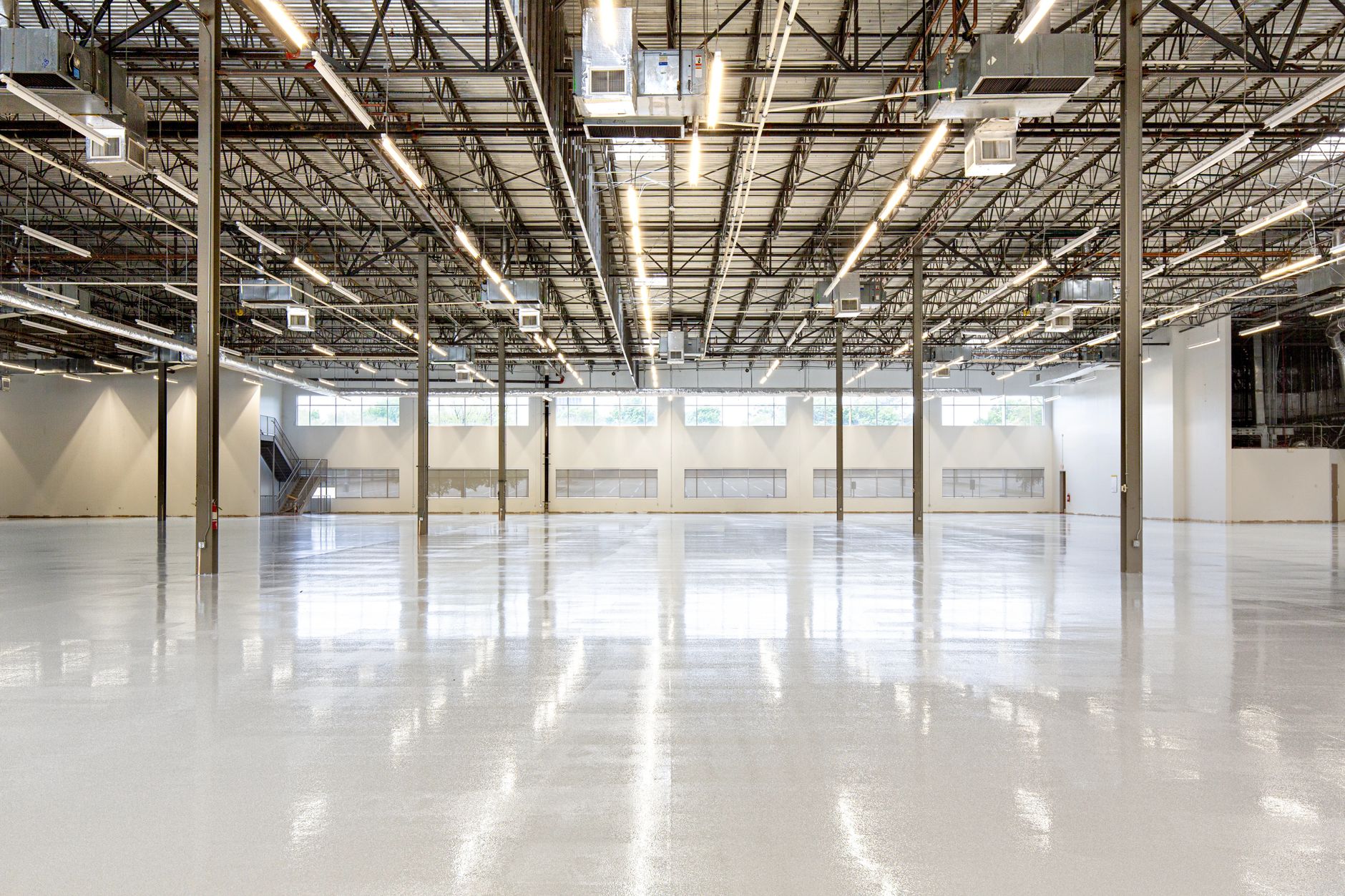
The shine is the part everyone buys and the part nobody thinks about until the first wet shift. A freshly coated resin floor under good lighting is impressive, and a smooth resin floor with a film of water on it has almost no grip at all. Those are the same fact. What makes the surface photograph well, a continuous sealed film with no open pores and no surface relief, is exactly what leaves a shoe sole riding on water instead of touching floor.
That is not a defect in the material and it is not a reason to avoid resin. It is a specification decision, and it is the one most commonly missing from a commercial proposal. Thickness gets named, colour gets named, cure times sometimes get named. Grip gets a single line saying anti slip additive included, which describes nothing you could check, compare, or ask for again in five years once the floor has stopped having any.
Getting a straight answer is mostly a matter of asking in the right units. Directory entries for commercial work around Collin County run names together in odd ways, so one crew can be listed as epoxy flooring allen prime epoxy flooring in one place and under something much shorter in another, and neither version tells you whether they specify texture room by room. What tells you that is whether the proposal names a material, a mesh, a rate and an area. Everything below exists so you can read that line.
Why a sealed floor is slick, and why matte does not fix it
Friction between a shoe and a dry floor comes from contact. Put water between the two and the contact area drops toward nothing, because the liquid has to be displaced before the sole can touch anything, and a perfectly smooth film gives it nowhere to go. At walking pace that is a small scale version of hydroplaning, and it happens on polished stone, on glazed tile and on resin alike.
Bare concrete with a broom finish avoids it almost by accident. The surface is porous and ridged, so water drains into the pores while the ridges break through the film and make real contact. A resin floor fills every one of those pores by design, which is the whole point in a space that has to be sanitised, and hands the water a flat plane to sit on.
The confusion worth clearing up is gloss. A satin or matte resin floor is not a slip resistant floor. Sheen comes from microscopic matting agents that scatter light, and those particles are far too small to punch through a water film or to give a sole anything to key into. Texture is geometry, measured in thousandths of an inch and coarser, and it is added deliberately as aggregate. A dead matte floor can be every bit as treacherous wet as a mirror finish. Judge grip with a wet hand, never with your eyes.
The wet dynamic coefficient of friction of 0.42 usually quoted in North American practice comes out of the tile standards, not from resin flooring, so treat it as a floor rather than a target. Any zone with standing water, grease or a slope needs considerably more.
How texture gets into the system
Broadcasting means the grit is thrown into a coat of resin while it is still wet, so the particles embed and stand proud of the film, and a further clear coat then locks them in. That top layer is what stops traffic kicking the aggregate loose. The texture comes out even, and the rate can be stated in pounds per hundred square feet, so it can be verified on the day and matched years later.
Suspending means the grit is stirred into the final coat and goes on with it. It is faster, it works well enough with light rounded polymer additives, and it has two real weaknesses: anything dense settles in the bucket, so the first pass and the last pass of one batch carry different amounts, and the roller drags material into the direction of travel, which leaves streaks of grip and streaks without it.
For a kitchen, a wash bay or a ramp, insist on a broadcast locked under clear. For a showroom, a suspended polymer is usually the right call.
The aggregates, and what each one feels like
Aluminum oxide is the aggressive option. It is very hard, sharply angular, and it stays sharp, which is why it holds its grip longer than anything else under real traffic. It is also abrasive to everything that touches it: mop heads shred on it, scrubber pads wear fast, cardboard dragged across it tears, and skin loses. This is the material for wash bays, dish pits, steep ramps and anywhere the consequence of a fall is severe.
Silica sand and coloured quartz sit in the middle. Sand is cheap and sub angular, so it grips well when new. Quartz granules do two jobs at once, providing the decorative surface and the texture together, which is why quartz broadcast systems turn up so often in commercial washrooms and utility spaces. Both are softer than aluminum oxide, so under hard polyurethane wheels or steel castors they round off sooner. Grinding a cured sand or quartz floor is a respirable silica job.
Polymer bead, sometimes a micronized polyolefin, is the gentle option. The particles are rounded and soft, they float rather than settle, and they break a water film while still reading as smooth to a bare hand. They are kind to mops, knees and bare feet, and they wear away faster than mineral grit under any real load. Excellent in retail, showrooms and entry areas, where a coarse floor would simply be unpleasant.
Mesh numbers run backwards from particle size: the higher the number, the finer the grit. Coarse grades in the teens and twenties are wash bay and ramp territory. The forties to sixties are the general commercial working range. The eighties upward give a perceptible but civilised tooth suited to corridors and light production, and anything finer than about one hundred and eighty is closer to a scuff resistant finish than a slip resistant one.
Texture trades directly against cleanability
Texture is peaks and valleys, and soil collects in the valleys. A mop head rides across the peaks and never reaches the bottom of them, so on a coarse floor a mop largely redistributes dirty water. That bites hardest exactly where the texture is most needed. In a kitchen the valleys fill with grease, the grease caps the aggregate over, and a floor specified coarse for safety ends up slicker than a smooth one would have been, with the grip still down there and unreachable.
So a coarse floor commits you to mechanical cleaning: an autoscrubber with a brush rather than a pad, enough deck pressure to reach into the profile, a degreaser matched to the soil, and recovery that lifts the solution instead of leaving it to dry back into the texture. A building with one mop bucket and no scrubber that specifies a heavy broadcast has specified a floor that will fail at its one job.
The honest sequence is to settle the cleaning method and the equipment budget first, then choose the coarsest texture that method can genuinely keep open.
Where each level belongs
A commercial kitchen wants the heaviest practical mineral broadcast, heavier again at the dish pit and along the fryer line, with a scrubber to match. A vehicle wash or equipment washdown bay wants coarse mineral plus the thing people forget, which is fall to a drain, because friction is a poor substitute for the water not being there at all.
Ramps and inclines want more grip than the flat floor they connect, because gravity already adds a forward shear the sole has to resist, and the steeper the ramp the wider that margin should be. Stair treads and landings are the same argument in miniature.
Entry vestibules deserve far more attention than they get. They are where outdoor water arrives on smooth soles at walking speed, and they need texture plus enough walk off matting to take the water out of the shoe before it reaches finished floor.
Warehouse aisles want light texture only: hard wheels flatten mineral grit quickly, packaging catches on it, and the real hazards there are dust and spills rather than standing water. Showrooms and offices want fine polymer at a modest rate, a satin sheen to hide scuffing, and no more tooth than that.
One rule cuts across all of them. A sudden change in grip is itself a hazard, because somebody crossing from a coarse kitchen onto a smooth corridor is still walking with the gait the last floor allowed. Put every change in texture at a doorway or a threshold where it is anticipated, never halfway along an open run.
Traffic lanes wear the texture off, unevenly
After a year or two the floor becomes a map of its own use. Wear concentrates in the walking lane, at the pivot point where everyone turns at a dock door or the end of a prep bench, along the pull path out of a walk in, and on the outside of every turn a cart takes.
Two different things happen there and they need opposite responses. The aggregate can be worn, meaning the clear over it has thinned and the exposed peaks have been rounded and polished, so less is standing proud than there was. Or the texture can be buried, meaning the profile is intact and full of grease, ground in soil, or the residue of a cleaner with a polish in it.
Telling them apart costs nothing. Scrub a small patch hard with the right degreaser and a brush, rinse, wet it, and test it against the lane beside it. If the grip comes back, the problem was always cleaning. If it does not, the texture is gone and no chemistry will return it. Keep a control area nobody walks on, under a rack or behind a door, and compare lanes against that rather than against memory.
Renewing it is the cheapest job in resin flooring
The good news is that texture lives in the topcoat, and the topcoat is the layer designed to be replaced. Renewal never touches the build coat, the primer or the bond.
The sequence is degrease, abrade, clean, then re broadcast into fresh clear and lock it. Degreasing comes first and matters most in food service, because abrading a greasy floor drives the contaminant down into the scratch pattern and the new coat then releases precisely where the old texture was worst. Abrading is mechanical, a diamond hone or sanding screens plus a hand tool at the perimeter, until no glossy islands are left.
Lane by lane renewal is legitimate, and one zone per night is how most busy buildings do it. Make the boundary deliberate, at a saw cut, a threshold or a line of columns. A recoat that stops in open floor leaves a sheen line and a friction change in the middle of a walking route, which is the transition hazard created on purpose.
What to set up on handover day is a record and a cycle. Write down, per zone, the aggregate, the mesh, the rate, whether it was broadcast or suspended, and how many clear coats went over it. Then schedule the lane recoat instead of letting an incident schedule it for you. A floor whose grip is checked against its own control patch and topped up on a known interval is a maintained property. A floor that was slip resistant on the day it was handed over is only a claim about one morning.